
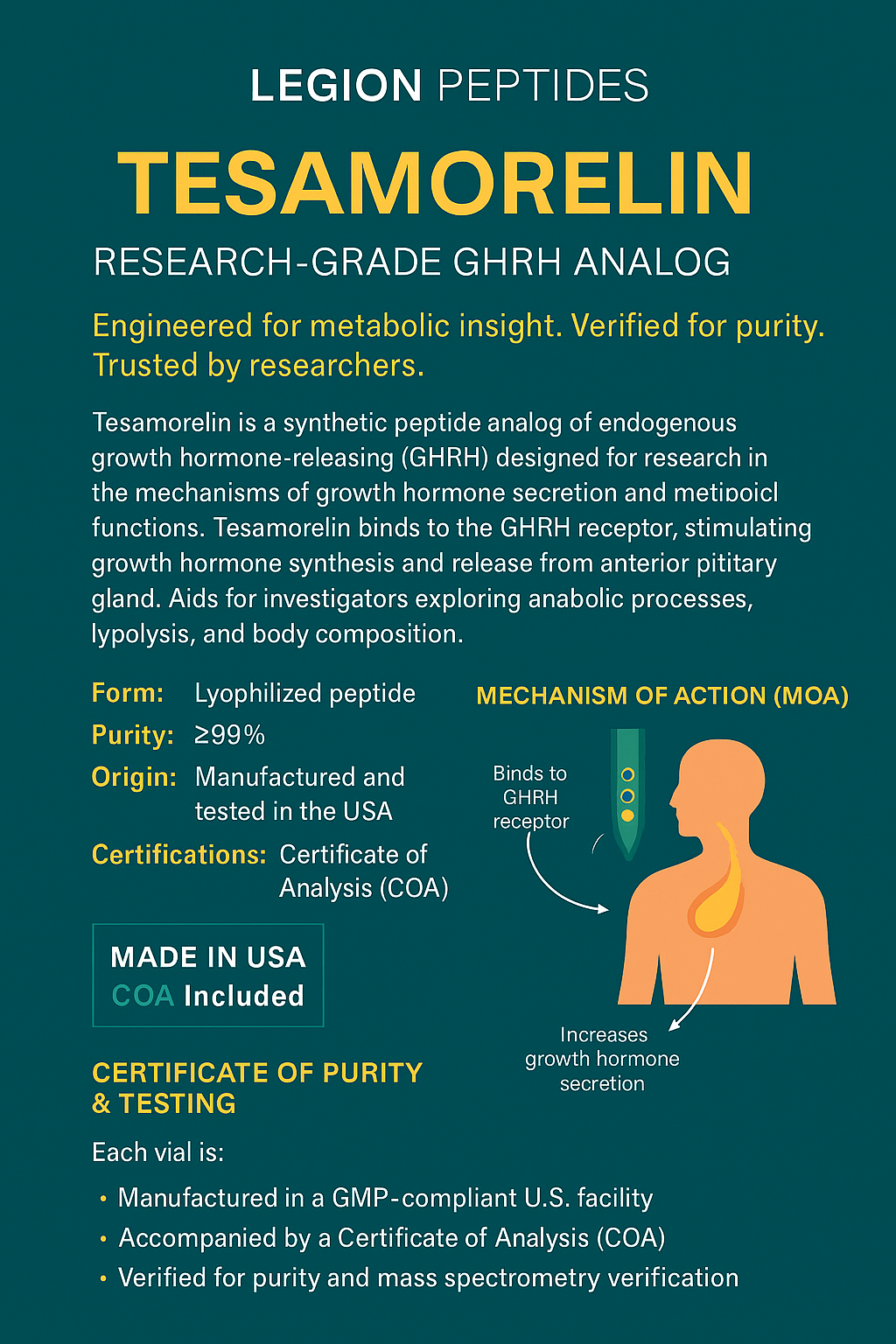
Tesamorelin Dosage Protocol (5 mg, 10 mg & 20 mg Vials)
Quickstart Highlights
Tesamorelin is a synthetic 44-amino-acid peptide analog of Growth Hormone-Releasing Hormone (GHRH)[1]. It stimulates endogenous growth hormone release and raises IGF-1 levels, leading to enhanced lipolysis and metabolic benefits[2]. Tesamorelin is FDA-approved for reducing visceral adipose tissue in HIV-associated lipodystrophy and is studied for metabolic disorders and aging research[3][4].
- Standard daily dose: 2 mg (2000 mcg) once daily subcutaneously (FDA-approved protocol).
- Week 1 Titration: Start with 1 mg (1000 mcg) daily to assess tolerability before advancing to 2 mg.
- Frequency: Once daily, preferably in the evening to coincide with nocturnal GH release.
- Storage: Lyophilized & Reconstituted: refrigerate at 2–8 °C (35.6–46.4 °F).
Dosing & Reconstitution Guide
Educational guide for reconstitution and daily dosing across different vial sizes
5 mg Vial Protocol (2.5 mL = 2.0 mg/mL)
| Week | Daily Dose (mg / mcg) | Units (per injection) (mL) |
|---|---|---|
| Week 1 | 1 mg / 1000 mcg | 50 units (0.50 mL) |
| Weeks 2–12+ | 2 mg / 2000 mcg | 100 units (1.00 mL) |
Reconstitution: Add 2.5 mL bacteriostatic water per 5 mg vial → 2.0 mg/mL concentration. At this concentration, 1 unit = 0.01 mL = 20 mcg on a U-100 insulin syringe.
Reconstitution Steps
- Draw 2.5 mL bacteriostatic water with a sterile syringe.
- Inject slowly down the vial wall; avoid foaming.
- Gently swirl until dissolved (do not shake).
- Label and refrigerate at 2–8 °C (35.6–46.4 °F), protected from light.
10 mg Vial Protocol (3.0 mL = ~3.33 mg/mL)
| Week | Daily Dose (mg / mcg) | Units (per injection) (mL) |
|---|---|---|
| Week 1 | 1 mg / 1000 mcg | 30 units (0.30 mL) |
| Weeks 2–12+ | 2 mg / 2000 mcg | 60 units (0.60 mL) |
Reconstitution: Add 3.0 mL bacteriostatic water per 10 mg vial → ~3.33 mg/mL concentration. At this concentration, 1 unit = 0.01 mL ≈ 33.3 mcg on a U-100 insulin syringe.
Reconstitution Steps
- Draw 3.0 mL bacteriostatic water with a sterile syringe.
- Inject slowly down the vial wall; avoid foaming.
- Gently swirl until dissolved (do not shake).
- Label and refrigerate at 2–8 °C (35.6–46.4 °F), protected from light.
20 mg Vial Protocol (3.0 mL = ~6.67 mg/mL)
| Week | Daily Dose (mg / mcg) | Units (per injection) (mL) |
|---|---|---|
| Week 1 | 1 mg / 1000 mcg | 15 units (0.15 mL) |
| Weeks 2–12+ | 2 mg / 2000 mcg | 30 units (0.30 mL) |
Reconstitution: Add 3.0 mL bacteriostatic water per 20 mg vial → ~6.67 mg/mL concentration. At this concentration, 1 unit = 0.01 mL ≈ 66.7 mcg on a U-100 insulin syringe.
Reconstitution Steps
- Draw 3.0 mL bacteriostatic water with a sterile syringe.
- Inject slowly down the vial wall; avoid foaming.
- Gently swirl until dissolved (do not shake).
- Label and refrigerate at 2–8 °C (35.6–46.4 °F), protected from light.
Supplies Needed
Plan based on an 8–16 week daily protocol at the standard 2 mg dose (after Week 1 titration).
For 5 mg Vials:
- Peptide Vials (8 weeks): ≈ 23 vials (112 mg total)
- Peptide Vials (12 weeks): ≈ 34 vials (168 mg total)
- Peptide Vials (16 weeks): ≈ 45 vials (224 mg total)
- Bacteriostatic Water (10 mL bottles): Use 2.5 mL per vial
For 10 mg Vials:
- Peptide Vials (8 weeks): ≈ 11 vials (105 mg total)
- Peptide Vials (12 weeks): ≈ 17 vials (161 mg total)
- Peptide Vials (16 weeks): ≈ 22 vials (217 mg total)
- Bacteriostatic Water (10 mL bottles): Use 3.0 mL per vial
For 20 mg Vials:
- Peptide Vials (8 weeks): ≈ 6 vials (105 mg total)
- Peptide Vials (12 weeks): ≈ 9 vials (161 mg total)
- Peptide Vials (16 weeks): ≈ 11 vials (217 mg total)
- Bacteriostatic Water (10 mL bottles): Use 3.0 mL per vial
Common Supplies for All Protocols:
- Insulin Syringes (U-100, 1 mL capacity): Per week: 7 syringes (1/day) → 8 weeks: 56 syringes, 12 weeks: 84 syringes, 16 weeks: 112 syringes
- Alcohol Swabs: Per week: 14 swabs (2/day) → 8 weeks: 112 swabs, 12 weeks: 168 swabs, 16 weeks: 224 swabs
Protocol Overview
Concise summary of the FDA-approved once-daily regimen.
- Goal: Reduce visceral adipose tissue and improve lipid profiles through sustained GH/IGF-1 elevation[3][4].
- Schedule: Daily subcutaneous injections for 12–26 weeks (extendable to 52 weeks with medical supervision)[3].
- Dose: 2 mg (2000 mcg) daily after Week 1 titration.
- Reconstitution: Varies by vial size for accurate measurement.
- Storage: Lyophilized refrigerated; reconstituted refrigerated; avoid freeze-thaw.
Dosing Protocol
FDA-approved daily dosing approach with tolerability titration.
- Week 1: 1 mg (1000 mcg) once daily to assess tolerability.
- Weeks 2+: 2 mg (2000 mcg) once daily (standard FDA-approved dose)[7][8].
- Frequency: Once per day (subcutaneous), preferably in the evening.
- Cycle Length: 12–26 weeks; clinical trials support up to 52 weeks with monitoring[3].
- Timing: Evening administration recommended; rotate injection sites.
Storage Instructions
Proper storage preserves peptide quality and efficacy.
- Lyophilized: Store at 2–8 °C (35.6–46.4 °F); newer formulations (Egrifta SV) stable at 20–25 °C (68–77 °F) before reconstitution[1].
- Reconstituted (with bacteriostatic water): Refrigerate at 2–8 °C (35.6–46.4 °F)[1].
- Reconstituted (with sterile water): Use immediately; discard any unused portion[1].
- Do not freeze reconstituted solution; avoid repeated freeze-thaw cycles.
Important Notes
Practical considerations for consistency and safety.
- Use new sterile insulin syringes for each injection; dispose in a sharps container[10].
- Rotate injection sites (abdomen at least 2 inches from navel, thighs, upper arms) to reduce local irritation[6][10].
- Inject slowly; wait a few seconds before withdrawing the needle.
- Monitor IGF-1 levels periodically due to potent GH stimulation; observe blood glucose in diabetic patients[9].
- Document daily dose and site rotation to maintain consistency.
How This Works
Tesamorelin mimics natural human GHRH by binding to pituitary GHRH receptors, triggering pulsatile growth hormone secretion and consequent IGF-1 elevation[2]. This cascade promotes lipolysis (fat breakdown), protein synthesis, and favorable metabolic shifts. In HIV-associated lipodystrophy, daily tesamorelin significantly reduces visceral adipose tissue and improves lipid profiles over 6–12 months[3][4]. Research also explores tesamorelin's potential to reduce liver fat in NAFLD patients and enhance cognitive function in older adults by restoring age-related GH/IGF-1 declines[4].
Potential Benefits & Side Effects
Observations from clinical trials and FDA-approved use.
Potential Benefits:
- Significant reduction in visceral adipose tissue (measurable after 3–6 months)[3].
- Improved lipid profiles and potential liver fat reduction in NAFLD[4].
- Enhanced cognitive function in older adults (research ongoing)[4].
- Well-tolerated with maintained benefits during continuous use up to 52 weeks[3].
Common Side Effects:
- Injection-site reactions: Mild redness, itching, pain, or bruising at injection area[9].
- Musculoskeletal symptoms: Joint pain (arthralgia), muscle aches, peripheral edema (mild swelling)[9].
- Carpal tunnel symptoms: Occasional tingling or numbness in extremities (dose-dependent, reversible).
- Metabolic monitoring: IGF-1 elevation requires monitoring; small increases in HbA1c observed in some patients[9].
Contraindications:
- Active malignancies (tesamorelin may accelerate growth of latent tumors)[9].
- Pregnancy (may harm fetus)[9].
- Known hypersensitivity to tesamorelin or mannitol[9].
Lifestyle Factors
Complementary strategies for optimal outcomes.
- Combine with a balanced, protein-forward diet to support GH/IGF-1 anabolic effects.
- Integrate resistance training and aerobic activity to maximize fat loss and metabolic benefits.
- Prioritize 7–9 hours of quality sleep to optimize natural GH pulsatility.
- Manage stress through mindfulness or relaxation techniques to support adherence and recovery.
Injection Technique
Subcutaneous injection best practices from clinical guidelines[10].
- Clean the vial stopper and skin with alcohol swabs; allow to air-dry completely.
- Pinch a skinfold at the injection site (abdomen preferred, at least 2 inches from navel)[6].
- Insert the needle at 90° (if adequate subcutaneous fat) or 45° (if lean)[10].
- Release the pinch, then inject slowly; wait 2–3 seconds before withdrawing.
- Rotate injection sites systematically (left/right abdomen, thighs, upper arms) to prevent lipohypertrophy[6].
- Dispose of used syringes immediately in a puncture-proof sharps container[10].
Recommended Source
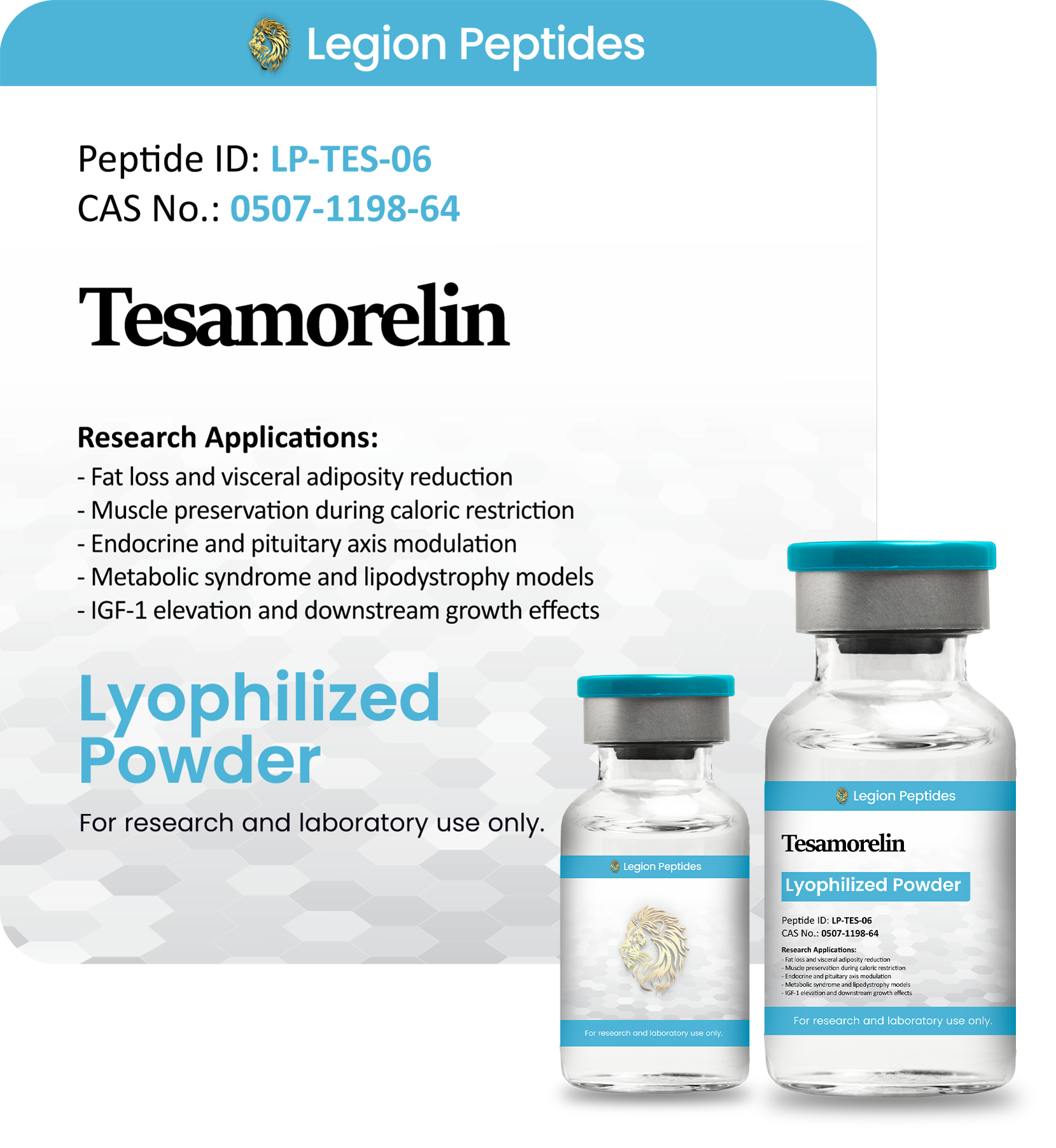
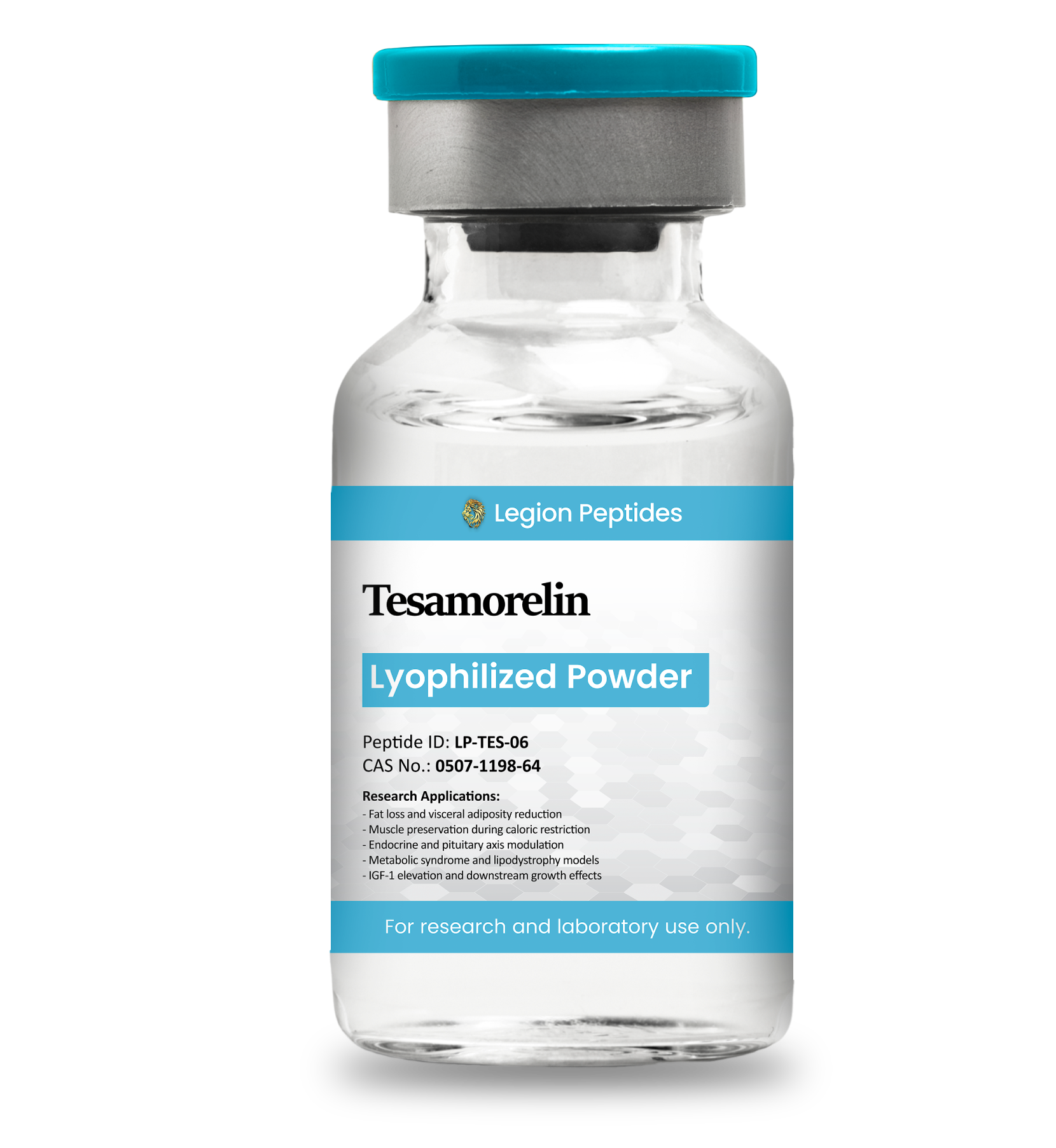
We recommend Legion Peptides for high-purity Tesamorelin (5 mg, 10 mg & 20 mg).
Why Legion Peptides?
- High-purity, third-party-tested lots with batch COAs (≥99% purity).
- Consistent, ISO-aligned handling and documentation.
- Reliable fulfillment to maintain cold-chain integrity.
- Dedicated customer support for research applications.
Important Note
This content is intended for therapeutic educational purposes only and does not constitute medical advice, diagnosis, or treatment. Tesamorelin is a prescription medication (FDA-approved as Egrifta®) for HIV-related lipodystrophy. Any off-label research use should comply with applicable laws and be conducted under appropriate supervision. This product is provided for laboratory research purposes only and is not intended for human or veterinary use. Consult a qualified medical professional before considering any therapeutic use of tesamorelin.
References
- Tesamorelin – LiverTox: Clinical and Research Information on Drug-Induced Liver Injury — National Institutes of Health, NIDDK (2018)
- Tesamorelin (Subcutaneous route) – Drug Information — Mayo Clinic / IBM Merative (2025)
- Effects of tesamorelin (TH9507), a growth hormone-releasing factor analog, in HIV-infected patients with excess abdominal fat: a pooled analysis of two phase 3 trials — J. Clin. Endocrinol. Metab. (2010)
- Safety and metabolic effects of tesamorelin in patients with type 2 diabetes: A randomized, placebo-controlled trial — PLoS ONE (2017)
- Tesamorelin can improve cognitive function (Research Highlight) — Nature Reviews Endocrinology (2012)
- Tesamorelin Injection – MedlinePlus Drug Information — MedlinePlus (U.S. National Library of Medicine) (2025)
- EGRIFTA SV (tesamorelin) – Full Prescribing Information — Theratechnologies, Inc. (FDA Label) (2024)
- Tesamorelin: Uses, Dosage, Side Effects, Warnings — Drugs.com (AHFS Monograph & Patient Info) (2025)
- Tesamorelin – LiverTox (Safety Profile) — NIH NIDDK LiverTox Database (2018)
- Administration of Parenteral Medications – Nursing Skills (Open RN Textbook) — Open RN, Chippewa Valley Technical College (2023)