Lyophilized Compounds Explained: What Freeze-Drying Means in Research Peptides
⚠️ Research Disclaimer:
This content is provided strictly for educational and research purposes. No information on this page constitutes medical advice, dosing guidance, or instructions for human or animal use.
Introduction
Lyophilization, commonly referred to as freeze-drying, is a dehydration process used to preserve sensitive biological compounds by removing water under controlled temperature and vacuum conditions.
Many research peptides are supplied in lyophilized form to enhance molecular stability, reduce degradation risk, and improve long-term storage integrity.
This guide explains:
- What lyophilization means
- How the freeze-drying process works
- Why research peptides are commonly lyophilized
- General stability and storage considerations
For a broader overview of peptide classifications and structure, visit the Research Peptides Hub or read What Are Research Peptides?
What Does Lyophilized Mean?
A lyophilized compound is a substance that has undergone freeze-drying — a process that removes water through sublimation (conversion of ice directly into vapor without becoming liquid).
The goal of lyophilization is to:
- Stabilize moisture-sensitive compounds
- Prevent hydrolytic degradation
- Extend storage viability
- Preserve molecular structure
Because peptides can be sensitive to moisture and environmental conditions, lyophilization is widely used in laboratory supply environments.
How the Lyophilization Process Works
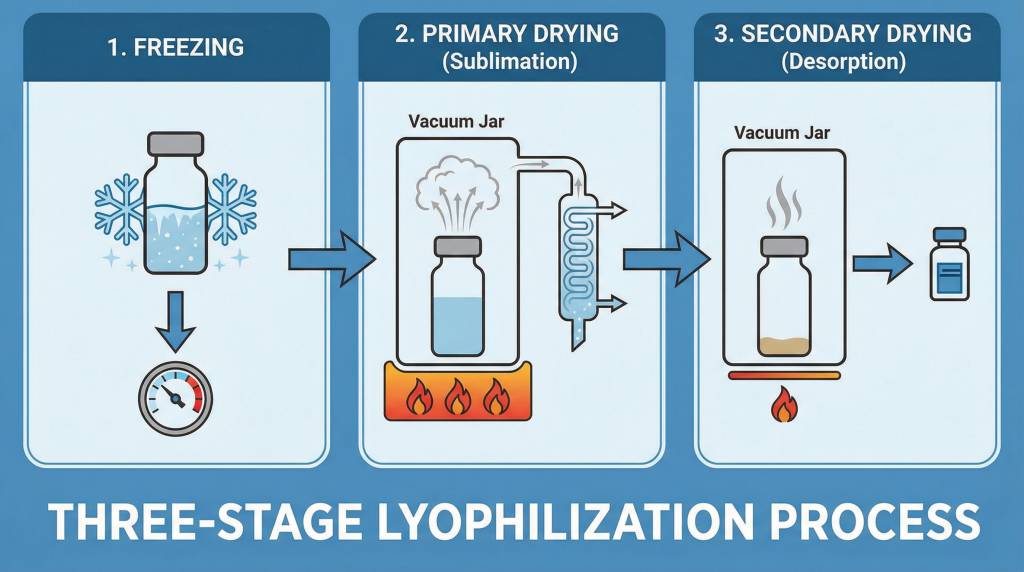
The freeze-drying process typically involves three controlled stages:
- 1️⃣ Freezing Phase: The compound is frozen at low temperatures, converting water into solid ice.
- 2️⃣ Primary Drying (Sublimation): Under reduced pressure (vacuum), ice transitions directly into vapor without becoming liquid. This removes the majority of water content.
- 3️⃣ Secondary Drying: Residual moisture is further reduced at slightly higher temperatures to achieve optimal stability.
Why Research Peptides Are Often Lyophilized
Peptides are chains of amino acids connected by peptide bonds. In solution, exposure to moisture and environmental factors can increase degradation risk over time.
Lyophilization provides several stability advantages:
- Reduces hydrolysis risk
- Minimizes oxidation exposure
- Improves long-term storage stability
- Simplifies transportation
- Maintains structural integrity prior to reconstitution
For information about peptide structure and signaling function, see:
→ What Are Research Peptides?
Lyophilized vs Reconstituted Compounds
A lyophilized peptide appears as a dry powder. Before laboratory analysis, it is typically reconstituted using a sterile solvent under controlled research conditions.
Key distinctions:
- Lyophilized Form: Dry, stable; lower moisture exposure; extended storage potential.
- Reconstituted Form: Mixed with solvent; increased sensitivity to temperature and contamination; requires appropriate storage conditions.
For general preparation principles, visit:
→ Reconstitution Calculator
→ Storage & Handling Guide
Stability Considerations in Laboratory Research
While stability varies depending on the specific compound and research conditions, general considerations may include:
- Refrigeration after reconstitution
- Protection from repeated freeze-thaw cycles
- Avoidance of excessive light exposure
- Use of sterile technique
Lyophilization significantly enhances baseline stability compared to aqueous storage.
Frequently Asked Questions
What does lyophilized mean in peptides?
It refers to peptides that have been freeze-dried to remove moisture and improve stability during storage and transport.
Why are research peptides freeze-dried?
Freeze-drying reduces moisture-related degradation and helps preserve molecular structure.
Does lyophilization change peptide structure?
When performed properly, lyophilization is designed to preserve structural integrity by preventing degradation during storage.
Are all peptides lyophilized?
Many research peptides are supplied in lyophilized form, but format can vary depending on laboratory use and manufacturer processes.
Educational Disclaimer
The information provided on this page is for educational and research-reference purposes only. Research peptides discussed herein are not approved for medical use and are intended solely for laboratory research conducted by qualified professionals.